
 Liverpool

 Newcastle United

 Chelsea

 Tottenham Hotspur

 Manchester City

 Atletico Madrid

 Churchill Brothers

 Northeast United FC

 Bengaluru FC

 East Bengal FC
India’s late header seals a historic hat-trick as second-string Blue Tigers deny Pakistan their first SAFF crown
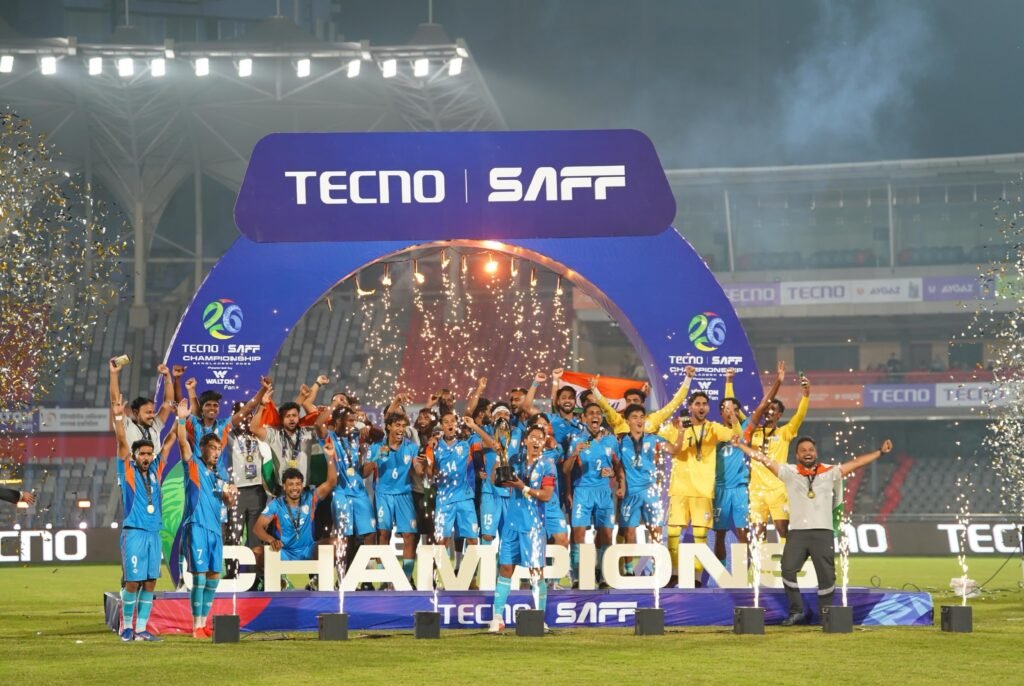
In the humid night air of Dhaka’s National Stadium on 17 November 2026, a rivalry older than the tournament itself produced a final that was less a celebration of South Asian football’s progress than a brutal reminder of its enduring hierarchies and fragilities. India, fielding what even their own federation acknowledged was a second-string side depleted by injuries, club refusals and departures, came from behind to beat Pakistan 2-1 and claim a record-extending tenth SAFF Championship title. More significantly, they became the first team in the competition’s history to win three consecutive editions (2021, 2023, 2026). For Pakistan, reaching their first final only to lose it after a second-half red card felt like a cruel punctuation mark on a campaign that had briefly suggested the gap was narrowing.
The match followed a familiar script of Indo-Pak football encounters: early dominance by one side, a moment of technical quality, a disciplinary flashpoint, and a late, almost inevitable Indian resolution. Pakistan controlled the first half with 65 per cent possession and greater territorial ambition. They stretched India down the flanks and created the clearer chances. Alamgir Ghazi’s 45+1st-minute goal was the logical outcome: a low delivery from Junaid Shah took a deflection off Khaiminthang Lhungdim and fell kindly; Ghazi controlled and curled a precise right-footed finish into the far corner. At the interval Pakistan deservedly led. India had been unsettled, their youthful and inexperienced squad struggling to impose any sustained rhythm.
The turning point arrived just before the hour. Junaid Shah’s rash challenge on Brison Fernandes was reviewed by VAR; the referee upgraded the decision to a straight red. Reduced to ten men, Pakistan’s structure collapsed. Within a minute India equalised. A delivery from the right — descriptions vary between a cross and a free-kick involving Lhungdim and Macarton Nickson — fell to Suhail Ahmad Bhat, who finished emphatically. Bhat, the tournament’s leading scorer and already a two-goal hero against Pakistan in the group stage, embodied India’s ability to extract maximum value from limited resources.
Thereafter the game became a siege. India introduced Abdul Rabeeh and Irfan Yadwad; the extra man and fresher legs told. In the 88th minute Rabeeh’s corner found Sandip Mandi unmarked. The East Bengal defender’s header bounced and nestled in the top corner. Mandi, later named player of the match, ripped off his shirt in celebration. Five minutes of added time produced no further drama. India had their tenth title; Pakistan were left reflecting on a historic opportunity squandered by a single moment of indiscipline.
The deeper context makes the result more telling than the scoreline. India arrived in Bangladesh with a severely constrained squad. Coach Naushad Moosa had only 17 outfield players available after injuries, overseas departures and clubs declining to release players. That a patchwork side could still win three successive SAFF titles underlines both India’s structural advantage within South Asia and the persistent shallowness of the region’s overall talent pool. Pakistan’s progress to the final — including a late semi-final winner against hosts Bangladesh — represented genuine improvement, yet the inability to manage a numerical disadvantage for half an hour exposed familiar limitations in depth, tactical flexibility and game management under pressure.
The India–Pakistan football rivalry remains peculiar. Unlike cricket, it carries less commercial heat and fewer geopolitical theatrics, yet it still generates disproportionate emotional voltage whenever the sides meet. In a competition of six teams played entirely in one stadium, the final carried the weight of national narratives: India’s continued regional hegemony versus Pakistan’s long-frustrated search for a first SAFF title. The 2026 final did not rewrite those narratives; it merely updated them with fresh evidence. India’s second string proved sufficient. Pakistan’s best effort was not.
For South Asian football the result is double-edged. India’s dominance provides a benchmark, but also a ceiling. As long as the strongest side in the region can field a depleted squad and still win the continental title, questions about the competitive health of the SAFF Championship remain legitimate. Pakistan’s near-miss will fuel domestic investment arguments and perhaps accelerate professionalisation efforts. Whether that translates into sustained closing of the gap is another matter. History suggests otherwise.
Sandip Mandi’s late header will be remembered as the decisive moment. The more lasting image may be of a second-string Indian team celebrating a third consecutive crown while a Pakistan side that had controlled large stretches of the final absorbed another familiar heartbreak. In South Asian football, some stories refuse to change.